llm-memory-calculator
Interactive memory calculator for large language models with 3D visualization
LLM Memory Calculator


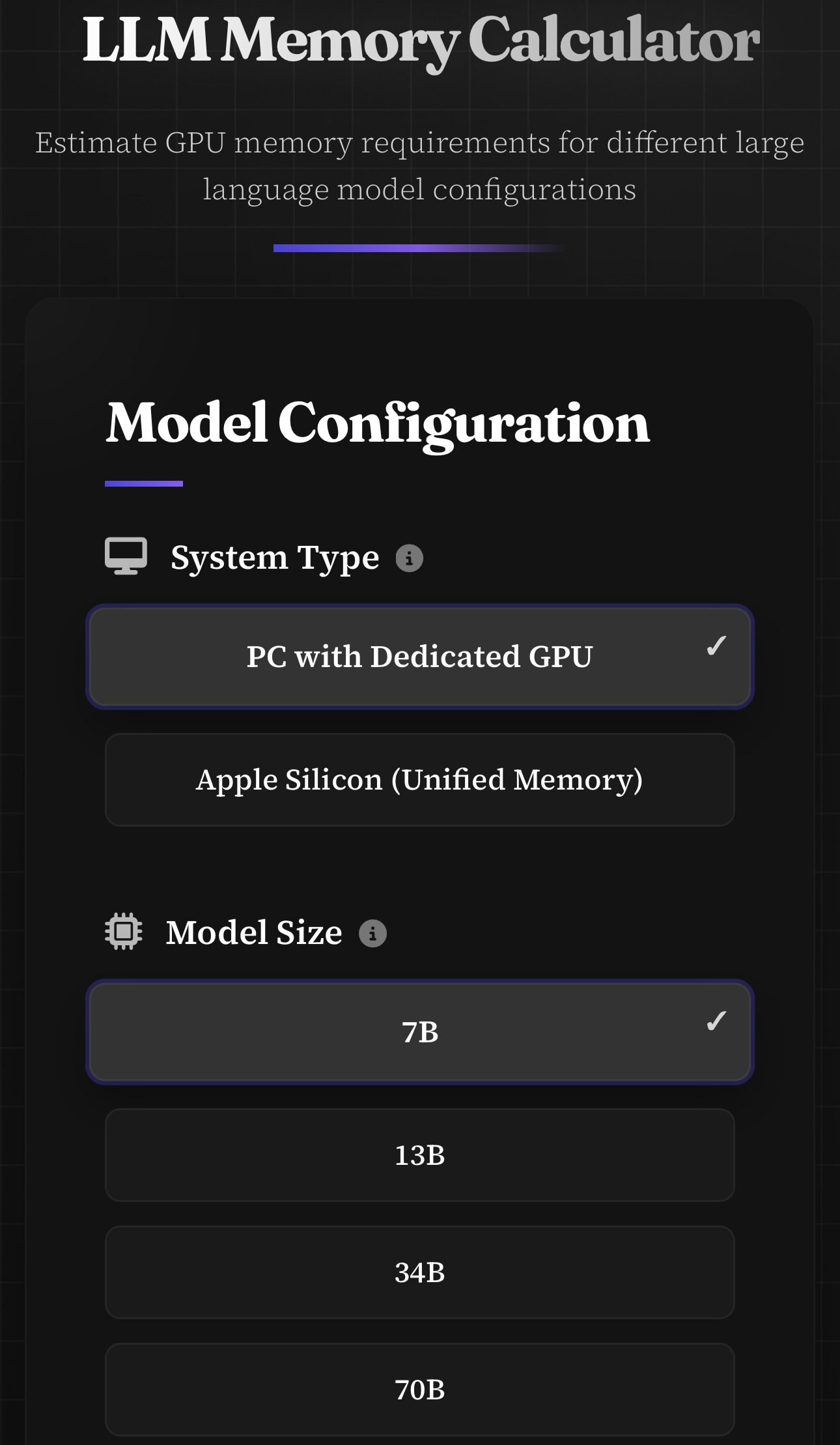
A standalone HTML/JavaScript application for calculating GPU memory requirements for large language models (LLMs). This tool assists AI practitioners in determining hardware requirements for inference, fine-tuning, and training from scratch.
Features
- Calculate memory requirements for models ranging from 7B to 175B+ parameters
- Support for different precision levels (32-bit, 16-bit, 8-bit, 4-bit, and Q4_K_M quantization)
- Estimates for different operation modes (inference, fine-tuning, training)
- Hardware recommendations for both NVIDIA GPUs and Apple Silicon
- Interactive 3D visualization of memory allocation components
- Single HTML file with no server requirements
Usage
Online Version
You can access the online version of this calculator at: https://deadjoe.github.io/llm-memory-calculator/
Local Usage
Simply open llm-memory-calculator.html or index.html in any modern web browser. No installation or server setup required.
Hosting Your Own Copy
To host this calculator on GitHub Pages:
- Fork this repository
- Go to your fork’s Settings tab
- Navigate to “Pages” in the left sidebar
- Under “Build and deployment”, select “Deploy from a branch”
- Select “main” branch and “/ (root)” folder
- Click “Save”
- After a few minutes, your calculator will be available at
https://yourusername.github.io/llm-memory-calculator/
Memory Calculation Algorithm
The calculator uses a comprehensive algorithm to estimate memory requirements based on real-world usage patterns rather than theoretical minimums. Below is the detailed calculation methodology:
Core Memory Components
-
Base Model Size (GB):
- Parameter Count (P) × Bytes per Parameter
- Bytes per parameter varies by precision:
- 32-bit (FP32): 4 bytes/parameter
- 16-bit (FP16/BF16): 2 bytes/parameter
- 8-bit Quantized: 1.2 bytes/parameter (includes quantization overhead)
- 4-bit Quantized: 0.65 bytes/parameter (includes metadata overhead)
- Q4_K_M Quantized: 0.59 bytes/parameter (more efficient 4-bit quantization)
-
Framework Overhead:
- 15% additional to base model size
- Accounts for PyTorch/TensorFlow runtime memory allocation
-
Operation Mode Multiplier:
- Inference: 1.05× multiplier (5% overhead)
- Fine-tuning: 2.5× multiplier (150% overhead)
- Training from Scratch: 4.0× multiplier (300% overhead)
-
Inference-specific Components (only applied in inference mode):
-
KV Cache:
- KV Cache (GB) = (Num Layers × 2 × Hidden Size × Context Length × Bytes per Parameter) ÷ 10^9
- Uses model-specific values for layers and hidden dimensions:
- 7B models: 32 layers, 4096 hidden dimension
- 13B models: 40 layers, 5120 hidden dimension
- 24B models: 48 layers, 6144 hidden dimension
- 34B models: 60 layers, 6656 hidden dimension
- 70B models: 80 layers, 8192 hidden dimension
- 175B+ models: 96 layers, 12288 hidden dimension
- Uses 8192 as the default context length
-
Activation Memory:
- Activation Memory (GB) = (Hidden Size × Context Length × Bytes per Parameter × 2) ÷ 10^9
-
-
CUDA/Runtime Buffer:
- 8% of total memory allocation
- Accounts for CUDA workspace and system buffers
-
System Architecture Factor:
- PC/NVIDIA: 1.0× (standard)
- Apple Silicon: 0.9× (unified memory efficiency)
-
Hardware Recommendation Safety Margin:
- 10% additional buffer for recommendations
- Ensures comfortable operation without memory pressure
Complete Formula
For inference mode:
Where:
For training/fine-tuning:
Hardware Recommendations
The calculator accounts for actual usable VRAM in its recommendations by reserving:
- ~2-8GB for system/CUDA runtime on NVIDIA GPUs
- ~2-20GB for system needs on Apple Silicon (depending on total RAM)
Development
The calculator is built with vanilla JavaScript and Three.js for visualizations. All computation happens client-side with no external API dependencies.
Technologies Used
- HTML5 and CSS3 for layout and styling
- Vanilla JavaScript (ES6+) for calculations
- Three.js for 3D memory visualization
- KaTeX for formula rendering
- Tween.js for smooth animations
License
This project is licensed under the MIT License - see the LICENSE file for details.
Acknowledgments
- Developed based on practical experience and benchmarks from running large language models
- Memory estimation formulas derived from real-world LLM deployment scenarios