promovolve
Promovolve is an attempt to get back what magazine advertising had!

An open-source ad network that targets content, not people.


Promovolve is an attempt to get back what magazine advertising had:
relevant ads matched to what the reader is actually reading, with no
cookies, no user profiles, no cross-site tracking, and no degradation of
the reading experience. The page’s content is the only targeting signal —
an article about hiking gets ads for hiking gear because of what it is,
not because of who is reading it.
Being open source is not incidental: transparency is the product.
Publishers and advertisers can read the auction, the pricing, and the
pacing logic and verify there is no hidden manipulation — something no
closed ad network can offer. For the guided version, read
the Promovolve book —
13 short chapters on why the system is built the way it is.
Demo
How it works
- A publisher adds two lines of HTML — a script tag and a
<div>
per ad slot. No SDK, no ad server account, no JavaScript to write. - Pages are classified on demand from real traffic: an LLM maps the
page’s text into IAB content categories the first time it serves. - Auctions run periodically per site, not on every page load.
Campaigns bid on content categories; a shortlist of candidates per
slot is cached in a replicated in-memory serve index, keeping the
serve path fast. - Thompson sampling picks the ad at serve time — candidates are
scored by a sampled engagement rate (magazine-opens and dog-ear
bookmarks, the latter weighted double) timesCPM^α, balancing
revenue against ad quality (α is publisher-configurable) and
exploring new creatives without re-running the auction. - Winners pay the minimum price that still wins — a
quality-adjusted second price set by the runner-up, never above the
winner’s own bid. Publisher floors are learned continuously from
observed demand, capped so a floor can never price out the top two
bidders in a competitive category. Where an advertiser is the only
bidder in a category, the floor tracks their bid (99%) — a monopolist
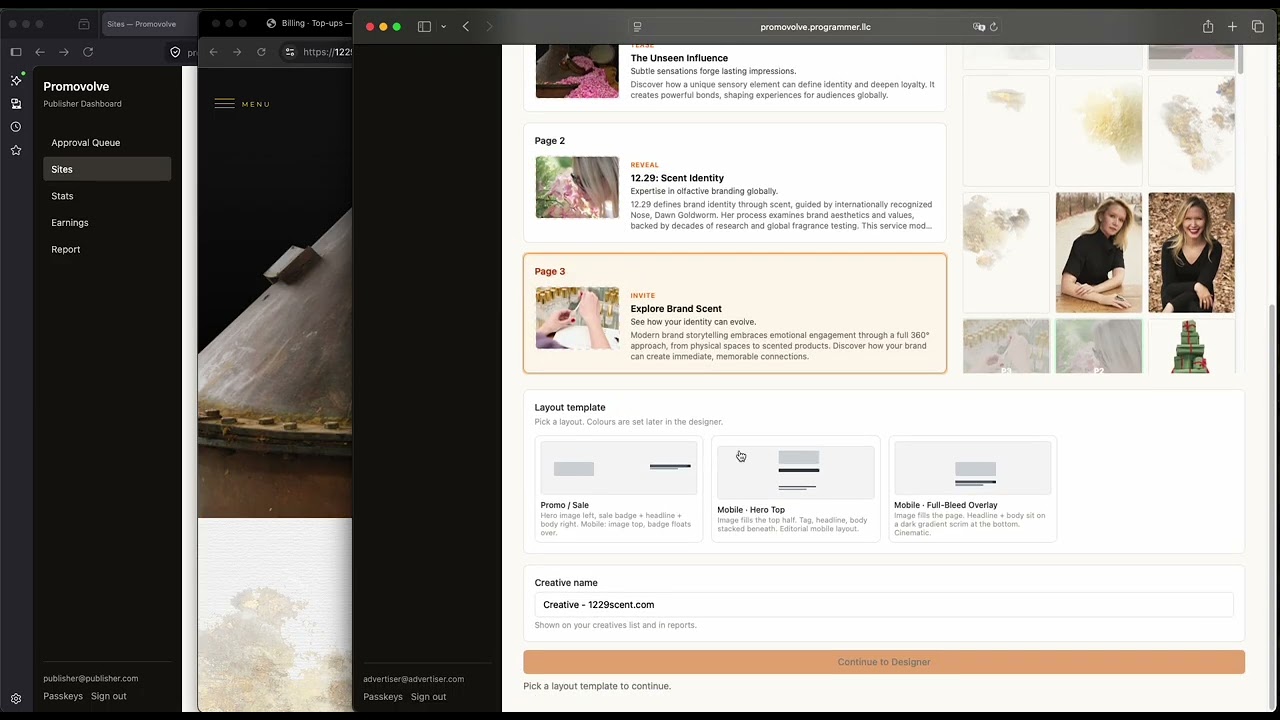
pays what they offered until competition arrives. - Creatives are generated, not uploaded. From an advertiser’s
landing page, Promovolve writes an original three-page “magazine”
creative — a compact banner that expands into a page-turning story.
Creatives are fluid: they scale to any slot dimensions.
Repository layout
| Path | What it is |
|---|---|
modules/ |
The core: a Scala / Apache Pekko cluster — auctions, serving, tracking, classification, creative generation |
platform/ |
The dashboard: a Go web app (server-rendered templates, passkey auth) plus the banner web component and the publisher loader script |
docs/ |
Documentation index — guides, architecture, design docs |
k8s/ |
Base Kubernetes manifests (Kustomize) |
k8s-gke/ |
The public GKE deployment: ARM spot cluster, GKE Ingress + managed certs, CI-deployed on push to main (.github/workflows/deploy.yml) |
docker/ |
Database schema (init-db.sql) and container bits |
scripts/ |
Dev runners, asset publish scripts, test harnesses |
Getting started
Pick your role:
- Run your own instance → Self-Hosting guide
- Put ads on your site → Publisher Integration guide
- Advertise → Advertiser Quickstart
For local development:
docker compose up -d postgres          # TimescaleDB on :5432 (detached)
cp scripts/.env.example scripts/.env   # fill in R2 credentials + an LLM API key
scripts/run-dev.sh --fresh             # core API on :8080
scripts/run-dashboard.sh               # dashboard on :9091
You’ll need JDK 21 and sbt, Go, Node.js, Docker, a Cloudflare R2 bucket, and
one LLM API key (Gemini, OpenAI, or Anthropic) — the core refuses to boot
without R2 and an LLM provider. Details in the
self-hosting guide.
Documentation
- The Promovolve book — the design, explained: format, classification, auction, pricing, pacing, floors, cluster (source repo)
docs/README.md— index of all guides and design docsdocs/ARCHITECTURE.md— system overview
Status
Active development, pre-1.0. Interfaces, schemas, and deployment layout
may still change without notice.
License
Licensed under the Apache License 2.0.