golang-algorithms
Algorithms and data structures implemented in Golang with explanations and links to further readings
Golang Algorithms and Data Structures and Go Solution for LeetCode algorithm problems


This repository contains Golang based examples of many
popular algorithms and data structures.
Each algorithm and data structure has its own separate README
with related explanations and links for further reading (including ones
to videos).
Read this in other languages:
简体中文
Data Structures
A data structure is a particular way of organizing and storing data in a computer so that it can
be accessed and modified efficiently. More precisely, a data structure is a collection of data
values, the relationships among them, and the functions or operations that can be applied to
the data.
B - Beginner, A - Advanced
BLinked ListBDoubly Linked ListBQueueBStackBHash TableBHeap - max and min heap versionsBPriority QueueATrieATreeABinary Search TreeAAVL TreeARed-Black TreeASegment Tree - with min/max/sum range queries examplesAFenwick Tree (Binary Indexed Tree)
AGraph (both directed and undirected)ADisjoint SetABloom Filter
Algorithms
An algorithm is an unambiguous specification of how to solve a class of problems. It is
a set of rules that precisely define a sequence of operations.
B - Beginner, A - Advanced
Algorithms by Topic
- Math
BBit Manipulation - set/get/update/clear bits, multiplication/division by two, make negative etc.BFactorialBFibonacci Number - classic and closed-form versionsBPrimality Test (trial division method)BEuclidean Algorithm - calculate the Greatest Common Divisor (GCD)BLeast Common Multiple (LCM)BSieve of Eratosthenes - finding all prime numbers up to any given limitBIs Power of Two - check if the number is power of two (naive and bitwise algorithms)BPascal’s TriangleBComplex Number - complex numbers and basic operations with themBRadian & Degree - radians to degree and backwards conversionBFast PoweringAInteger PartitionALiu Hui π Algorithm - approximate π calculations based on N-gonsADiscrete Fourier Transform - decompose a function of time (a signal) into the frequencies that make it up
- Sets
BCartesian Product - product of multiple setsBFisher–Yates Shuffle - random permutation of a finite sequenceAPower Set - all subsets of a set (bitwise and backtracking solutions)APermutations (with and without repetitions)ACombinations (with and without repetitions)ALongest Common Subsequence (LCS)ALongest Increasing SubsequenceAShortest Common Supersequence (SCS)AKnapsack Problem - “0/1” and “Unbound” onesAMaximum Subarray - “Brute Force” and “Dynamic Programming” (Kadane’s) versionsACombination Sum - find all combinations that form specific sum
- Strings
BHamming Distance - number of positions at which the symbols are differentALevenshtein Distance - minimum edit distance between two sequencesAKnuth–Morris–Pratt Algorithm (KMP Algorithm) - substring search (pattern matching)AZ Algorithm - substring search (pattern matching)ARabin Karp Algorithm - substring searchALongest Common SubstringARegular Expression Matching
- Searches
BLinear SearchBJump Search (or Block Search) - search in sorted arrayBBinary Search - search in sorted arrayBInterpolation Search - search in uniformly distributed sorted array
- Sorting
BBubble SortBSelection SortBInsertion SortBHeap SortBMerge SortBQuicksort - in-place and non-in-place implementationsBShellsortBCounting SortBRadix Sort
- Linked Lists
- Trees
BDepth-First Search (DFS)BBreadth-First Search (BFS)
- Graphs
BDepth-First Search (DFS)BBreadth-First Search (BFS)BKruskal’s Algorithm - finding Minimum Spanning Tree (MST) for weighted undirected graphADijkstra Algorithm - finding shortest paths to all graph vertices from single vertexABellman-Ford Algorithm - finding shortest paths to all graph vertices from single vertexAFloyd-Warshall Algorithm - find shortest paths between all pairs of verticesADetect Cycle - for both directed and undirected graphs (DFS and Disjoint Set based versions)APrim’s Algorithm - finding Minimum Spanning Tree (MST) for weighted undirected graphATopological Sorting - DFS methodAArticulation Points - Tarjan’s algorithm (DFS based)ABridges - DFS based algorithmAEulerian Path and Eulerian Circuit - Fleury’s algorithm - Visit every edge exactly onceAHamiltonian Cycle - Visit every vertex exactly onceAStrongly Connected Components - Kosaraju’s algorithmATravelling Salesman Problem - shortest possible route that visits each city and returns to the origin city
- Cryptography
BPolynomial Hash - rolling hash function based on polynomial
- Uncategorized
BTower of HanoiBSquare Matrix Rotation - in-place algorithmBJump Game - backtracking, dynamic programming (top-down + bottom-up) and greedy examplesBUnique Paths - backtracking, dynamic programming and Pascal’s Triangle based examplesBRain Terraces - trapping rain water problem (dynamic programming and brute force versions)AN-Queens ProblemAKnight’s Tour
Algorithms by Paradigm
An algorithmic paradigm is a generic method or approach which underlies the design of a class
of algorithms. It is an abstraction higher than the notion of an algorithm, just as an
algorithm is an abstraction higher than a computer program.
- Brute Force - look at all the possibilities and selects the best solution
BLinear SearchBRain Terraces - trapping rain water problemAMaximum SubarrayATravelling Salesman Problem - shortest possible route that visits each city and returns to the origin cityADiscrete Fourier Transform - decompose a function of time (a signal) into the frequencies that make it up
- Greedy - choose the best option at the current time, without any consideration for the future
BJump GameAUnbound Knapsack ProblemADijkstra Algorithm - finding shortest path to all graph verticesAPrim’s Algorithm - finding Minimum Spanning Tree (MST) for weighted undirected graphAKruskal’s Algorithm - finding Minimum Spanning Tree (MST) for weighted undirected graph
- Divide and Conquer - divide the problem into smaller parts and then solve those parts
BBinary SearchBTower of HanoiBPascal’s TriangleBEuclidean Algorithm - calculate the Greatest Common Divisor (GCD)BMerge SortBQuicksortBTree Depth-First Search (DFS)BGraph Depth-First Search (DFS)BJump GameBFast PoweringAPermutations (with and without repetitions)ACombinations (with and without repetitions)
- Dynamic Programming - build up a solution using previously found sub-solutions
BFibonacci NumberBJump GameBUnique PathsBRain Terraces - trapping rain water problemALevenshtein Distance - minimum edit distance between two sequencesALongest Common Subsequence (LCS)ALongest Common SubstringALongest Increasing SubsequenceAShortest Common SupersequenceA0/1 Knapsack ProblemAInteger PartitionAMaximum SubarrayABellman-Ford Algorithm - finding shortest path to all graph verticesAFloyd-Warshall Algorithm - find shortest paths between all pairs of verticesARegular Expression Matching
- Backtracking - similarly to brute force, try to generate all possible solutions, but each time you generate next solution you test
if it satisfies all conditions, and only then continue generating subsequent solutions. Otherwise, backtrack, and go on a
different path of finding a solution. Normally the DFS traversal of state-space is being used.BJump GameBUnique PathsBPower Set - all subsets of a setAHamiltonian Cycle - Visit every vertex exactly onceAN-Queens ProblemAKnight’s TourACombination Sum - find all combinations that form specific sum
- Branch & Bound - remember the lowest-cost solution found at each stage of the backtracking
search, and use the cost of the lowest-cost solution found so far as a lower bound on the cost of
a least-cost solution to the problem, in order to discard partial solutions with costs larger than the
lowest-cost solution found so far. Normally BFS traversal in combination with DFS traversal of state-space
tree is being used.
Useful Information
Big O Notation
Big O notation is used to classify algorithms according to how their running time or space requirements grow as the input size grows.
On the chart below you may find most common orders of growth of algorithms specified in Big O notation.

Source: Big O Cheat Sheet.
Common Data Structure Operations

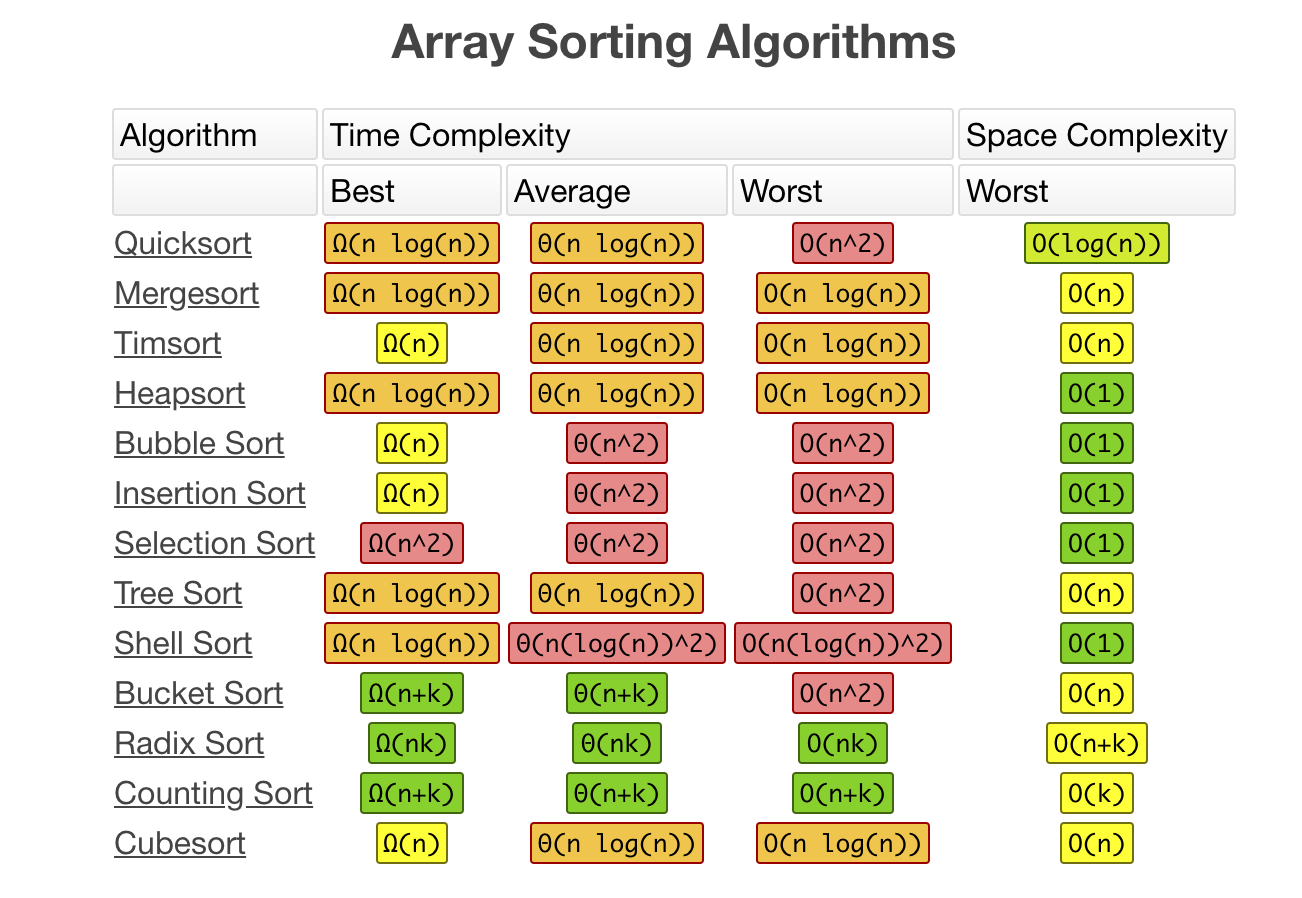
Array Sorting Algorithms